

I recently started a position as an economist at my local electric utility, and one of the goals of my team is to forecast electricity demand. We use weather patterns, economic growth projections, rooftop solar adoption rates, energy efficiency trends, and more, to predict future load. Most of the variation in load can be explained by weather as we heat or cool our buildings.
Using regression analyses, decision trees, and other models, we can give you a pretty good guess as to what electricity demand will be in Albuquerque at any given hour over the next decade or two. I think it’s pretty cool, but as my auntie told me the other day, I’m more like a glorified weather man.
It’s important for utility planners to know how much load growth is going to occur in the future because they need to prepare generation plants, string up transmission lines, and upgrade substations to serve customers and, hopefully, do so with the climate in mind. This takes planning, but planning is difficult when you have so much uncertainty around the things that will either increase or decrease load in the future.
Data centers, electric cars, heat pumps, and industrial electrification will all require more electricity, while rooftop solar, residential batteries, and energy efficiency will continue to decrease or smooth out demand. To make matters worse, climate change will likely decrease load in the winter and increase it in the summer.
As our cities sprawl into what were once natural habitats, roads, parking lots, and buildings absorb more heat - exacerbating the negative effects of climate change. Anecdotally, I have felt it get hotter in Albuquerque since I was a kid, but I turned to nearly a century of weather data to understand the scale of it. Using regression and geospatial analysis, I parsed out where the warming is actually coming from. We can’t blame it all on climate change.
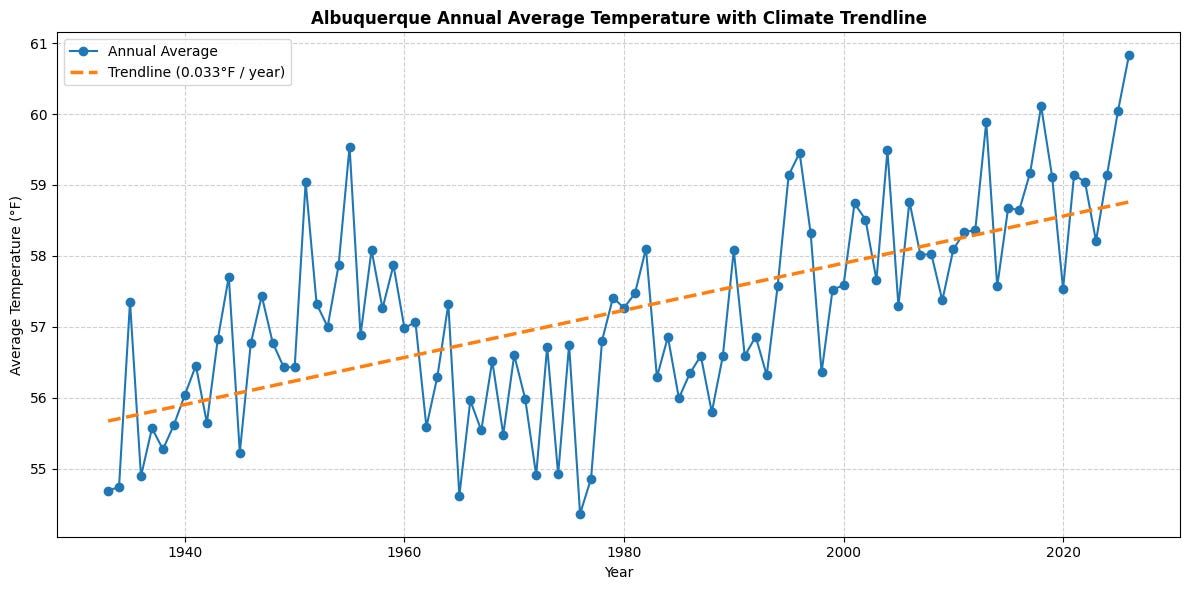
As seen in the graph above, it’s not just my imagination - it is, in fact, getting hotter in Albuquerque. Almost a century worth of weather data from the Albuquerque Sunport shows that the average daily temperature has been increasing. Since 1932, the top four hottest years on average were 2025, 2017, 2024, 2012, and seven out of the top ten hottest years have occurred since 2000.
There has been an average warming trend of 0.033°F every year since 1932 - or about 1/3rd of a degree every decade. That doesn’t sound like too much, but stacked up over 100 years, it starts to change a region drastically.
The New Mexico Energy, Minerals, and Natural Resources Department (EMNRD) states that greenhouse gas emissions will continue to increase temperatures in the Southwest by 0.2°F a decade - which is smaller than the increase I measured for Albuquerque. Furthermore, the EPA expects larger temperature increases in the summer and fall - which also differs from my own estimations using local data. I find that the winter and spring are warming faster than the summer and fall in the Duke City.
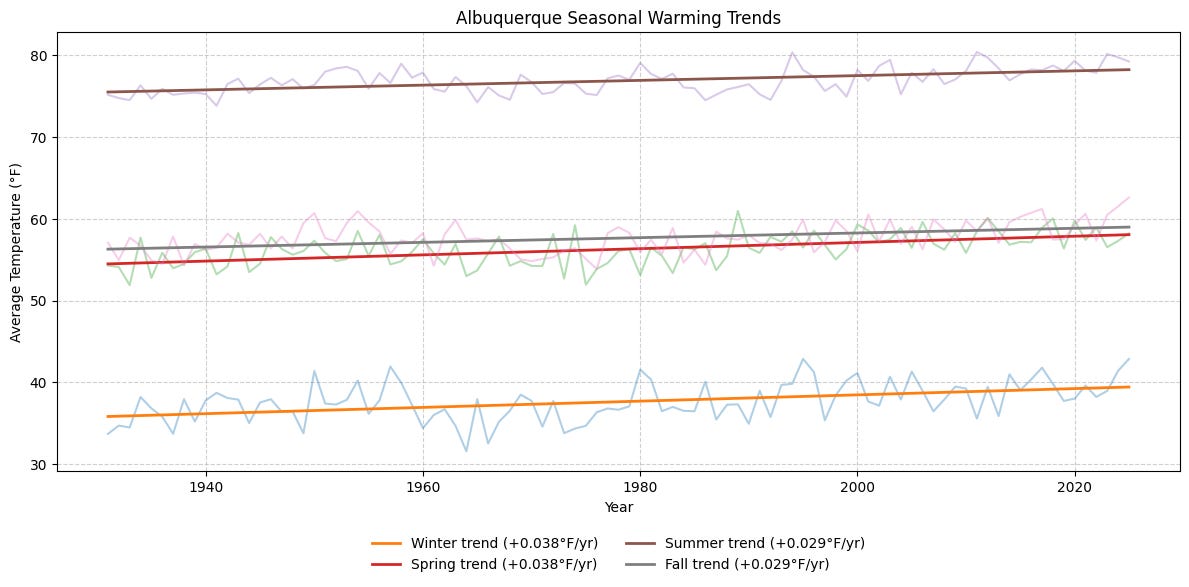
The differences come from the fact that I’m using temperature measurements from within the city, and EMNRD and the EPA are predicting using estimations based on the greater Southwest region. These differences suggest that Albuquerque is warming faster than the rest of the region, but why?
To investigate this further, I measured the difference in average temperatures between the 1930s and the 2020s, and broke out the average lows and highs from each time period. What we find is that a lot of the increase in temperature is coming from higher overnight lows.
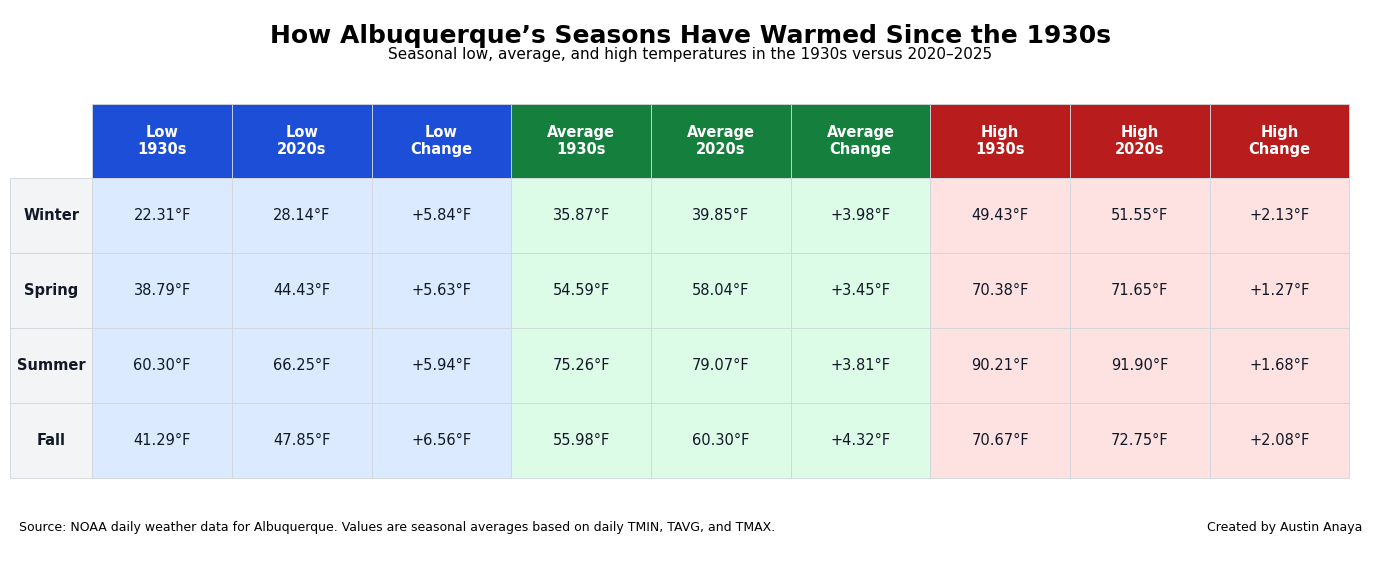
The average seasonal low is about 6°F higher today than in the 1930s. Yet, the average high has only increased 1 or 2 degrees, which is more consistent with the EPA estimates. So, the EPA isn’t wrong, it’s just that their estimate isn’t specific to cities.
Cities often suffer from the heat island effect - a phenomenon in which roads, buildings, and parking lots absorb more heat than the surrounding natural landscape. We often hear about these “heat islands,” but, similar to greenhouse gases, heat islands are an abstract idea for us to see and understand at times. Therefore, I measured the change in built environment in the Albuquerque metro area to see how much of an effect it’s had on local temperatures.
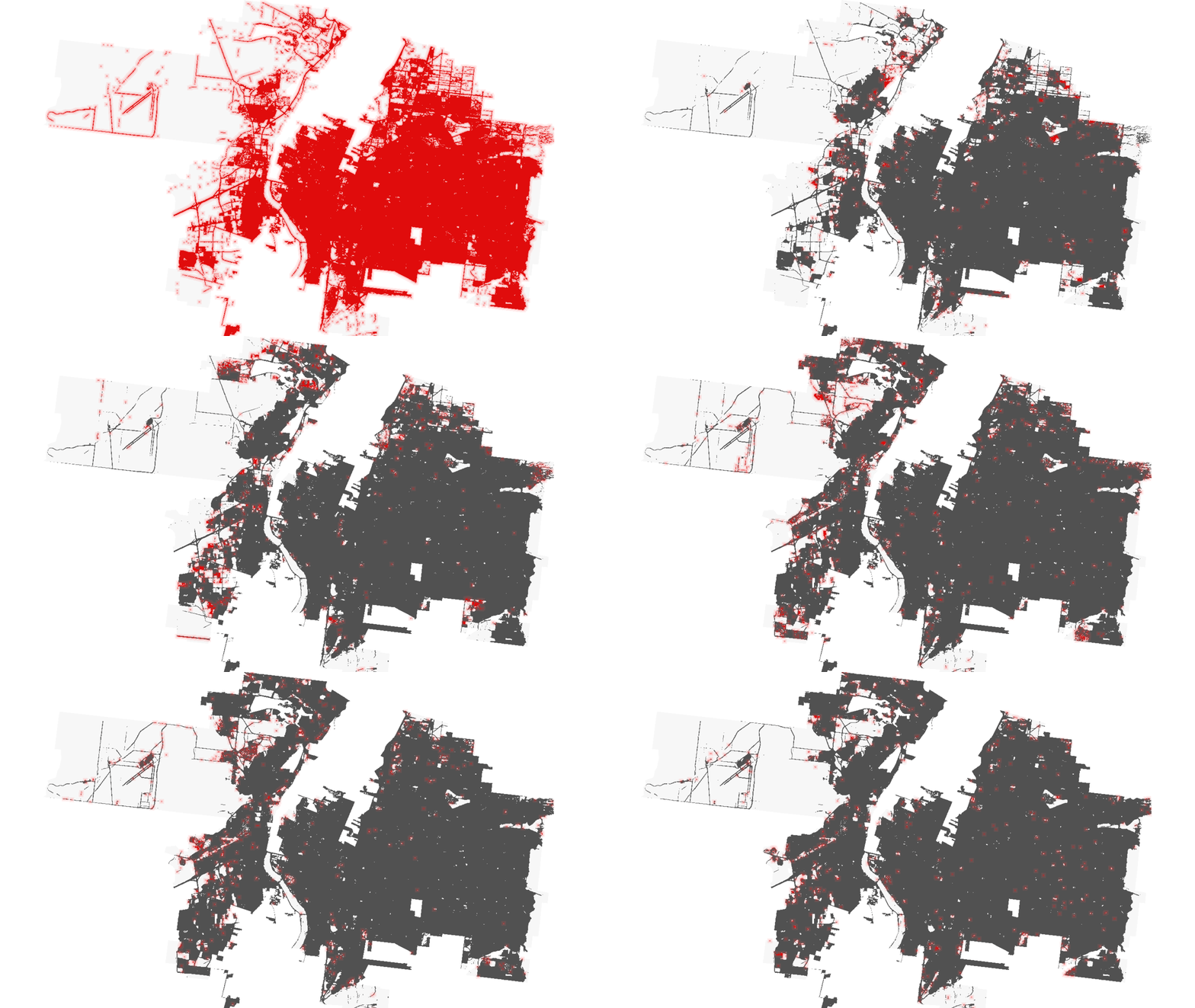
The graphic below shows the increased development in Albuquerque and the greater metro area.
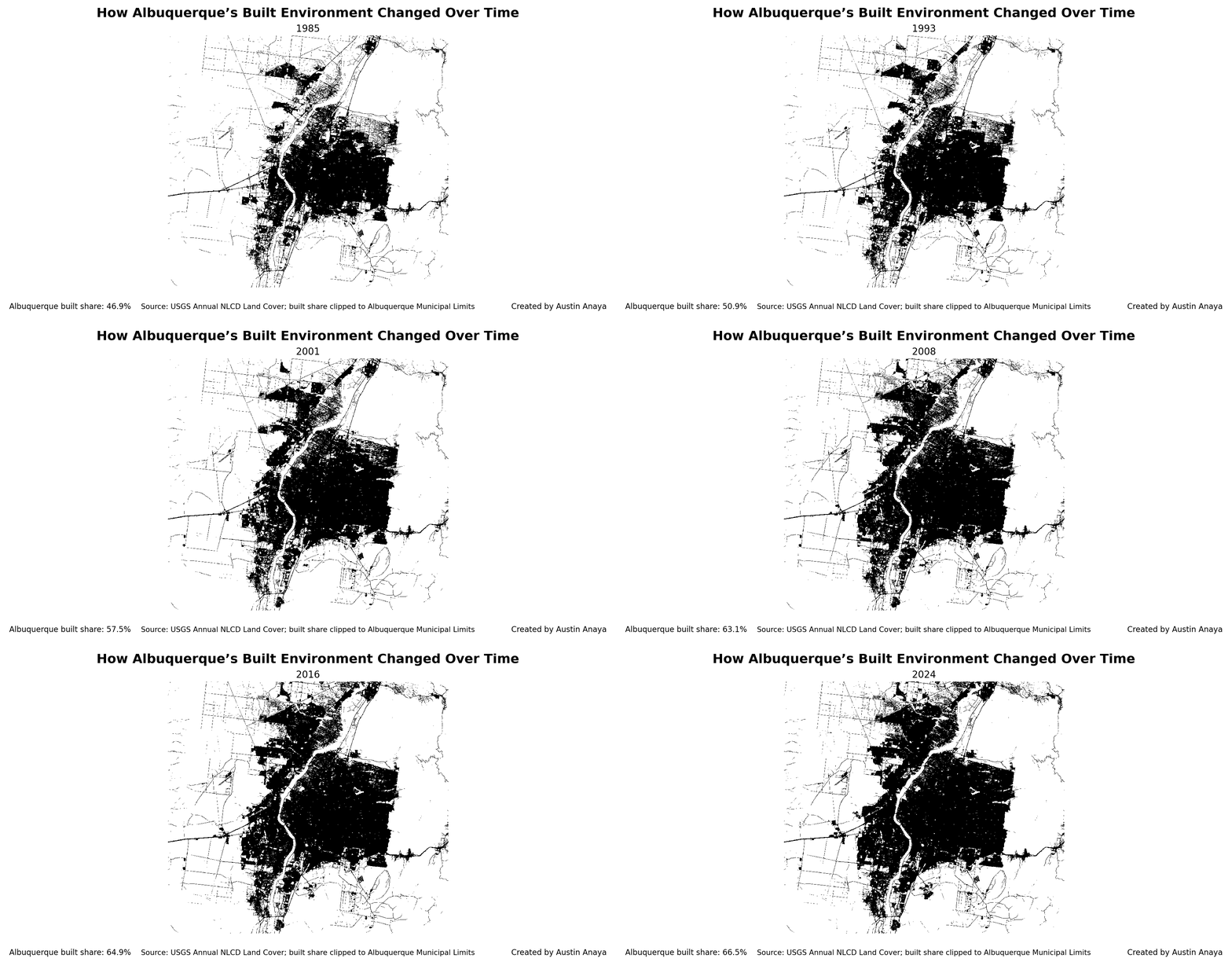
The increasing surface area of concrete and asphalt captures heat during the day and releases it at night. To verify that the heat island effect is why Albuquerque is warming faster than the rest of the region, I ran some more back-of-the-envelope regressions.
Controlling for wind, rain, snow, and monthly variations in temperature, I estimated the correlation between daily low and high temperatures with the growth in development, which I measure as the percentage of the Albuquerque city limits that has been built on. I call this variable ‘built share’. I find that for every percent increase in the built share, the daily low temperature increases 0.15°F while the daily high increases by just 0.05°F. As you can see in the graphic above, we’ve seen a nearly 20% increase in the built share since the late 1980s, meaning our built environment has contributed to increases of almost 3°F in overnight lows and 1°F in daytime highs in that timeframe.
These results are likely a little off since I’m only using temperature data from one location and the greenhouse gas effect is difficult to parse out at the local level. But it helps explain why Albuquerque is warming faster than the EPA says it should. These results simply put numbers to what we already knew - our built environment exacerbates climate change.
Climate change is a global phenomenon. Albuquerque will continue to get warmer even if New Mexico halts GHG emissions today because emissions from the rest of the globe will increase temperatures everywhere. This reality urges many in Albuquerque and elsewhere to question the value of local climate action. Why concern ourselves with reducing emissions if it doesn’t help us directly? It’s the tragedy of the commons.
Luckily, most New Mexicans do care about the climate, and we’ve put some policies in place to decarbonize some of our highest emitting sectors. But there aren’t currently any major programs to stop or reverse the heating effects of urban sprawl. The Energy Transition Act will guide our electricity sector to decarbonize, yet the warming issue will remain.
As a load forecaster, I know that our electricity needs will increase with heat. Swamp coolers are becoming less sufficient, and people will need more electric-intensive air conditioning to adapt to the heat. This will cost everyone money through HVAC and grid infrastructure upgrades, but electricity is only part of the adaptation costs we will likely incur.
Extreme heat depreciates infrastructure faster than normal - the energy grid, roads, and water systems will all have shorter lifespans. Heat also affects labor productivity, biodiversity, forest coverage, outdoor recreation, and more. There’s no aspect of our lives that heat won’t affect.
Now, there’s an expensive way to adapt, and there’s a less expensive way. We can do a lot to minimize these damages outside of decreasing emissions. We ought to be seriously rethinking our built environment - highways, parking lots, and car-centric urban planning have serious long-term costs to our health and economy, but we can change that.
We can utilize our land more efficiently to reduce heat, beautify, and save money. We can rethink the empty parking lots by building up instead of out, leaving more room for greenery. These are policy choices that currently lack political will, but as the thermometer keeps rising, politicians will feel the heat eventually.
Great read... and yes, swamp coolers are no longer working for many of our homes in certain parts of Albuquerque. I have seen more mini-splits in homes in the last few years then when I first started in real estate over 10 years ago. This is a real thing.
Is there any data or evidence that shows how a hyperlocal environment can mitigate or even alleviate the broader effects of climate change? I.e., can one's city be cooler than the baseline through effort taken? I'm thinking of Sam Bloch's book "Shade," although I don't remember if it answers that question exactly.